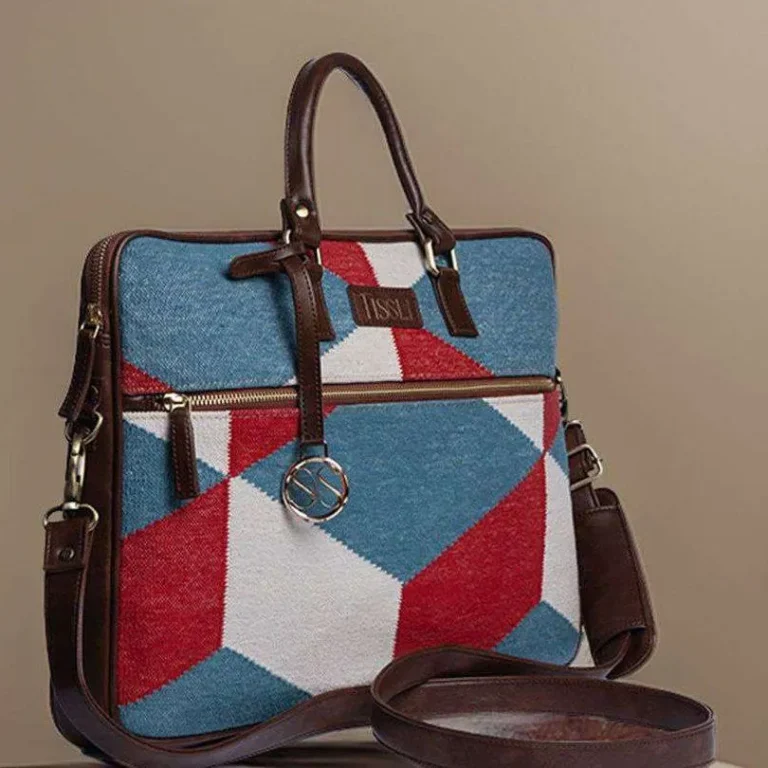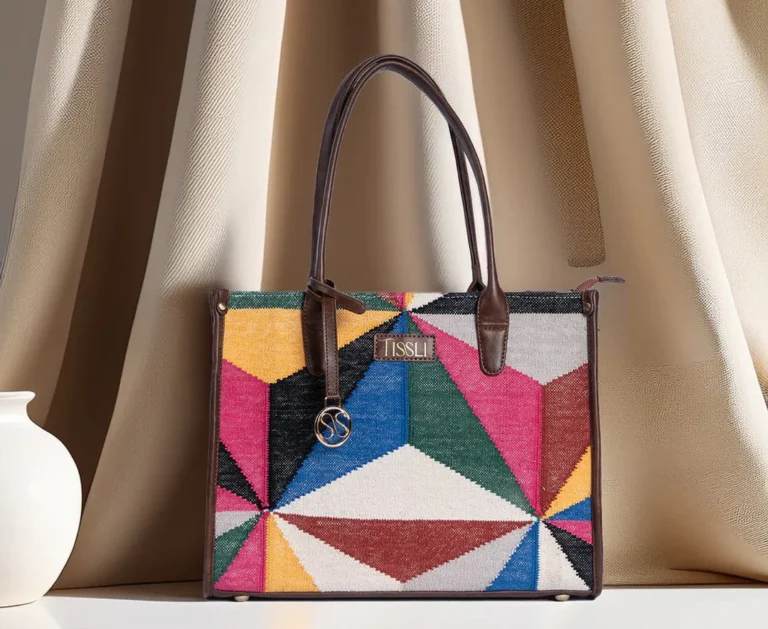
Turn a Tissli bag over in your hands and you will notice something: there is no fuzzy pile, no loose knots, nothing to shed. The surface is flat, tight and firm. That is because our woven pieces begin life as a flat-woven rug, the family of textiles known around the world as kilims, and in India as dhurries.
What makes a kilim a kilim
Most carpets are made by tying thousands of small knots onto a frame of threads and trimming them into a soft pile. A kilim is different. It has no pile at all. The weaver passes coloured weft threads over and under the vertical warp threads and packs them down so tightly that the warp almost disappears. The pattern lives inside the weave rather than sitting on top of it.
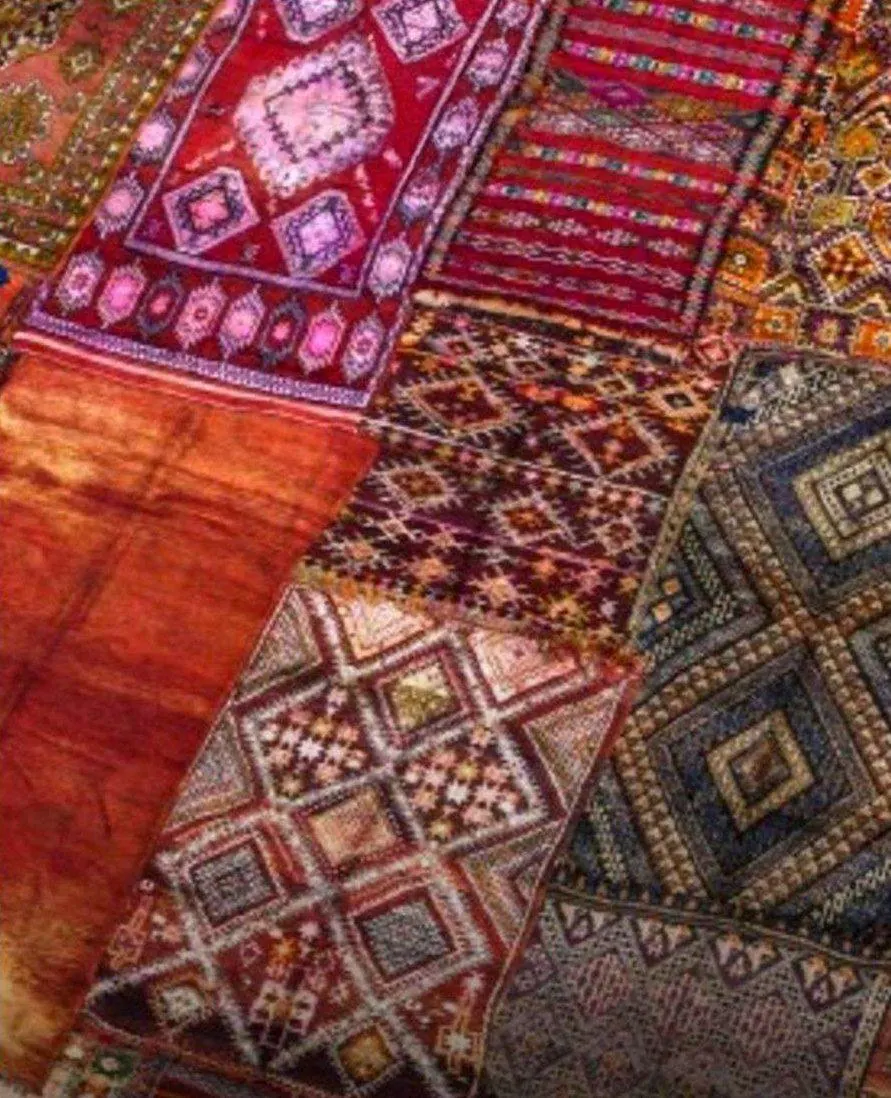
Flat-weaving is one of the oldest ways people have made textiles, and it is found in many weaving cultures, from Anatolia and Persia to Central Asia and the Indian subcontinent. Each region has its own motifs, colours and techniques, but the principle is the same: a dense, durable cloth woven entirely by hand.
The Indian dhurrie, and the panja
In India, flat-woven rugs are called dhurries. They have been woven for generations, traditionally in cotton, and Rajasthan is one of the places most closely linked with them. Many of our pieces use the panja technique. Panja means a paw or claw, and it is the name of the heavy metal comb the weaver uses to beat each row of weft down firmly against the last. Row by row, the comb gives the weave its strength and its crisp, even surface.
The pattern is not printed on. It is built, thread by thread, as the cloth itself grows.
Why a flat-weave makes such a good bag
- It is strong. Tightly packed weft makes a cloth that holds its shape and stands up to daily use.
- It does not shed. With no pile, there is nothing to pill or wear bald at the corners.
- It is light for its strength. You get the character of a rug without the weight of a carpet.
- Both sides tell the story. Because the design is woven through, the colours stay rich and the pattern stays sharp.
From a rug to a Tissli
Our rug bags are made from vintage handwoven rugs, cut and stitched by hand in Jaipur. That is why no two are ever the same: the colours, the motif and even the small irregularities come from one particular rug, woven by one particular pair of hands, years before it became your bag. When we say one of one, we mean it literally.
If you would like to see each step, from the rug to the finished piece, take a look at The Craft. And if a weave has caught your eye, the collection is waiting.